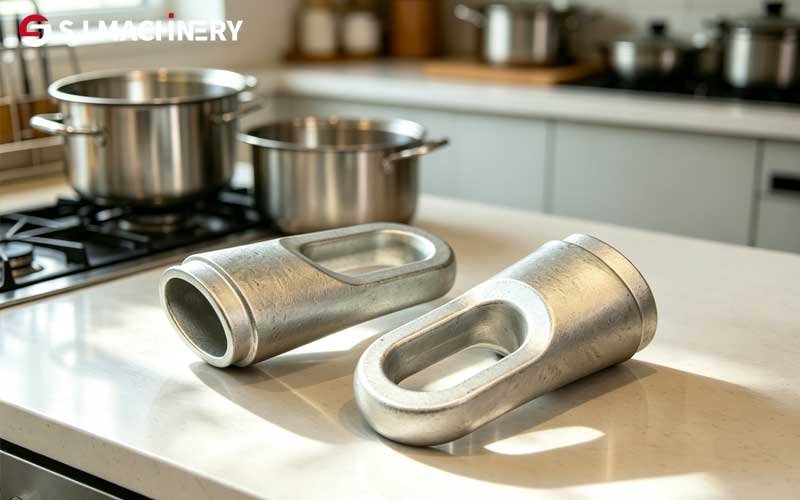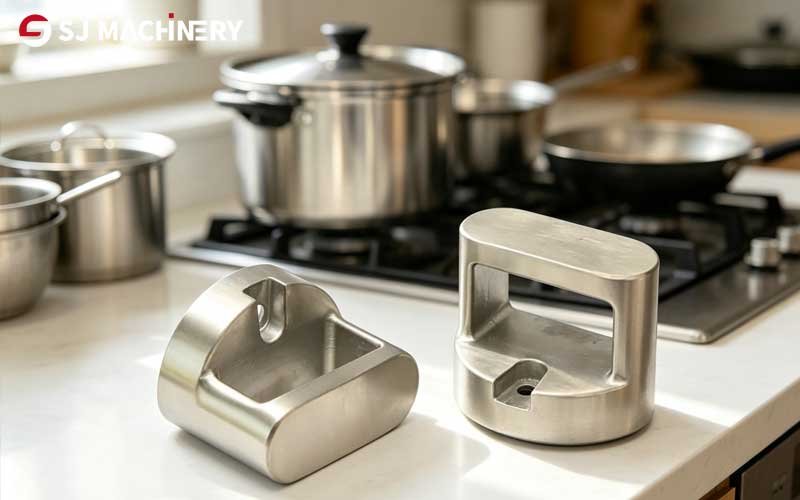
For cookware manufacturers, kitchen hardware distributors, and OEM/ODM procurement buyers, the structural stability, high-temperature resistance, and surface finish of pot and pressure cooker handles directly determine product safety, service life, and market competitiveness.
Traditional stamping and welding handles often suffer from loose joints, rough edges, poor high-temperature durability, and easy rusting, leading to high after-sales failure rates and customer complaints. Investment casting (lost wax casting) stainless steel handles solve these industry pain points perfectly, delivering integrated molding, high precision, superior mechanical performance, and excellent corrosion resistance, becoming the mainstream high-end accessory choice for commercial and household pressure cookers and cooking pots worldwide.
1. Core Advantages of Investment Casting Stainless Steel Cookware Handles
Different from conventional metal forming processes, investment casting adopts precision lost wax molding technology, which realizes one-piece integral forming without welding seams. Combined with food-grade stainless steel raw materials, the finished handles meet strict kitchen safety standards and long-term high-frequency use requirements.
- – Superior Material Performance: Adopts 304/316 food-grade stainless steel as standard raw material, featuring high-temperature resistance up to 600℃, acid and alkali corrosion resistance, rust-proof performance, and non-toxic, hygienic properties. It adapts to long-term high-pressure and high-temperature cooking environments, avoiding deformation, oxidation, or metal precipitation that occurs in iron and ordinary alloy handles.
- – Integrated Seamless Molding: The lost wax investment casting process eliminates welding gaps and assembly joints. The overall structural strength is significantly improved, effectively preventing breakage, loosening, and falling off during high-pressure cooking and heavy-load handling, greatly improving the safety factor of pressure cookers.
- – High Precision & Fine Surface Finish: The casting dimensional tolerance can reach CT4-CT6 level, with no burrs, trachoma, or rough surfaces. After polishing and passivation treatment, the surface is smooth and easy to clean, complying with food contact hygiene standards and high-end cookware appearance requirements.
- – Strong Customization Compatibility: Supports personalized customization of ergonomic shapes (V-type, Y-type, curved grip), mounting hole positions, thickness, and surface treatments, compatible with 3L–12L commercial and household pressure cookers and various stainless steel cooking pots.
- – Long Service Life & Low Maintenance: Excellent mechanical toughness and anti-fatigue performance, suitable for long-term repeated use in home kitchens, restaurants, and catering institutions, reducing after-sales replacement costs for brands.
2. Process Comparison: Investment Casting vs. Traditional Handle Manufacturing
The following table intuitively compares the differences between investment casting process and traditional stamping/welding process in terms of performance, quality, and application scenarios, helping buyers select cost-effective solutions for different product positioning.
|
Evaluation Dimension
|
Investment Casting (Lost Wax) Handle
|
Traditional Stamping & Welding Handle
|
|---|---|---|
|
Molding Structure
|
Integrated seamless one-piece molding, no welding joints
|
Split stamping + welding assembly, obvious joint gaps
|
|
치수 정확도
|
High tolerance precision, consistent batch size
|
Low precision, easy to produce batch size deviation
|
|
High-Temp & Pressure Resistance
|
No deformation under long-term high temperature and pressure, stable structure
|
Easy thermal deformation, welding joints prone to cracking
|
|
Surface Quality
|
Smooth polished surface, no burrs, easy cleaning
|
Rough welding traces, easy to hide dirt and rust
|
|
Service Life
|
5–8 years of stable service, low failure rate
|
2–3 years average service life, high breakage rate
|
|
Application Positioning
|
Mid-to-high-end pressure cookers, commercial cookware
|
Low-end ordinary cooking pots, entry-level cookware
|
3. Key Material & Process Parameters Focused by Foreign Trade Procurers
Global cookware importers, quality inspectors, and purchasing engineers prioritize verifiable, standard-compliant material and process parameters for investment casting stainless steel handles. These core indicators are critical for customs clearance, third-party testing, product certification, and batch quality stability, which directly determine product market eligibility and after-sales risk control. Below are the most concerned technical parameters for overseas procurement:
3.1 Core Material Chemical & Physical Parameters
- – Stainless Steel Composition Standard: Adopt international standard 304 (06Cr19Ni10) and 316 (06Cr17Ni12Mo2) food-grade stainless steel, with strictly controlled carbon content ≤0.08%, chromium content 18.00%–20.00%, nickel content 8.00%–11.00% for 304 grade. The qualified material composition completely complies with EU LFGB and US FDA food contact standards, avoiding heavy metal precipitation during high-temperature cooking.
- – Mechanical Property Indicators: The tensile strength of finished casting handles ≥520MPa, yield strength ≥205MPa, elongation rate ≥40%. These parameters ensure the handles resist breakage and deformation under long-term high-pressure bearing and frequent handling, meeting the mechanical safety standards for household and commercial pressure cookers.
- – Corrosion Resistance Performance: Pass 48-hour neutral salt spray test with no rust, oxidation or surface discoloration. The overall passivation treatment enhances the material’s resistance to acid, alkali and humid marine environments, which is suitable for long-distance ocean transportation and high-humidity overseas market use.
3.2 Key Investment Casting Process Parameters
- – Dimensional Tolerance Standard: Strictly implement ISO 8062 casting tolerance standard, with dimensional accuracy up to CT4-CT6. The error of mounting hole spacing, overall length and bending radian is controlled within ±0.1mm, ensuring perfect assembly compatibility with matched cookware bodies and zero assembly failure in batch production.
- – Casting Surface Quality Standard: No casting defects including porosity, trachoma, shrinkage cavity, crack and burr. The surface roughness Ra ≤0.8μm after precision polishing and passivation, which meets the high hygiene requirements of food contact accessories and is easy for daily cleaning and sterilization.
- – High & Low Temperature Resistance Parameters: Continuous working temperature range from -40℃ to 600℃, no structural deformation, surface cracking or performance attenuation after repeated high-temperature cooking and cold and hot alternation. It adapts to diverse cooking scenarios and seasonal temperature changes in global markets.
- – Process Molding Standard: Full lost wax investment casting integral molding, no welding, no secondary assembly. The overall structural density reaches 100% with no internal hollow gaps, effectively avoiding structural fracture risks caused by welding joint failure.
3.3 Batch Production & Quality Control Parameters
- – Batch Consistency Rate: Strict mold opening and unified process parameter control, with batch product consistency rate ≥99.5%, no obvious deviation in size, surface effect and mechanical performance among different batches, supporting long-term repeated order procurement for overseas buyers.
- – Defect Rate Control: Finished product inspection pass rate ≥99.8%, zero major safety defects (cracks, missing materials, unqualified material composition), minor appearance defect rate strictly controlled within 0.2%.
- – Surface Treatment Process Standard: Uniform mirror polishing/wire drawing/matte polishing + professional chemical passivation double treatment, improving surface hardness and anti-oxidation ability, ensuring long-term use without rusting and discoloration.
4. Procurement Value & Service Advantages
For cookware brands and hardware distributors, selecting investment casting stainless steel handles can effectively optimize product quality and brand reputation while controlling comprehensive procurement costs.
- First, the integrated casting structure greatly reduces product failure rates and after-sales maintenance costs, improving end-customer satisfaction and repurchase rate.
- Second, standardized production and strict batch quality inspection ensure zero difference in mass-produced products, supporting buyers’ large-scale inventory replenishment and long-term stable supply.
- In addition, we provide full-cycle OEM/ODM customized services, including shape optimization, size adjustment, logo engraving, and personalized surface processing, to help buyers differentiate their products in the competitive mid-to-high-end cookware market.
All products support factory direct sales, short delivery cycles, and flexible payment terms, bringing stable and profitable procurement solutions for global cookware customers.