Permanent Mold Casting Process
Permanent Mold Casting Introduction
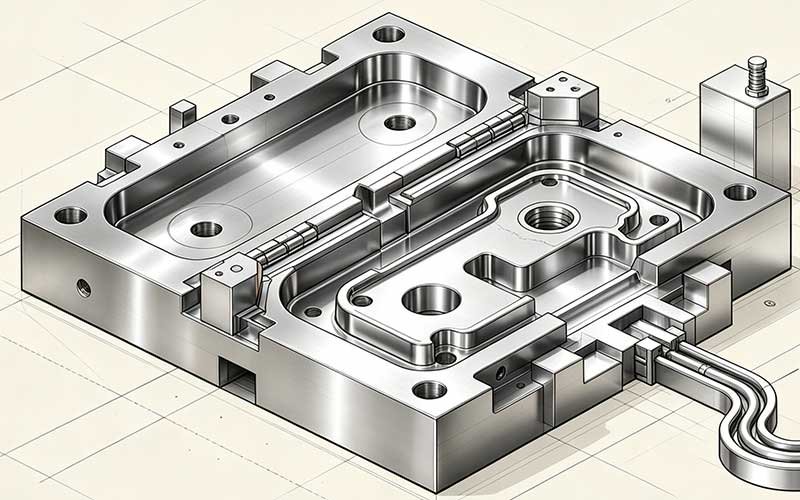
Permanent Mold Casting (also known as Hard Mold Casting / Metal Mold Casting) is a high-efficiency, repeatable metal forming process that uses reusable hardened metal molds instead of single-use sand molds. Designed for medium-to-high volume production, this process delivers dimensionally accurate, dense, and high-strength metal components with superior surface finish compared to traditional sand casting.
The metal mold can be reused for thousands of casting cycles, which significantly reduces per-unit production costs and ensures consistent part quality for industrial mass production.
This technology is widely applied in aluminum, magnesium, zinc, and copper alloy manufacturing.
Permanent Mold Casting Process
Permanent Mold Casting is a rigorous, repeatable industrial manufacturing process with standardized parameter control at every stage. The full workflow covers mold preparation, metal treatment, precision pouring, controlled solidification, post-treatment and quality inspection. Each step is strictly optimized to eliminate common defects (porosity, cold shut, shrinkage, crack, flash) and ensure consistent dimensional tolerance, mechanical performance and surface quality for mass production.
Suijin Machinery implements a standardized, quality-controlled full-cycle casting workflow to guarantee defect-free and high-precision finished parts.
Step 1: Custom Mold Design & Precision Fabrication
We design professional permanent metal molds according to customer 2D/3D drawings and product application requirements.
The full mold system includes precision gating channels, directional riser systems, exhaust slots, side core-pulling structures and automatic ejection mechanisms. Molds are manufactured with high-strength mold steel or ductile iron, processed by CNC precision machining and heat treatment to enhance hardness, wear resistance and thermal stability.
Custom multi-cavity mold design is available to greatly improve production efficiency for bulk orders, with a mold service life of thousands to tens of thousands of casting cycles.
Step 2: Mold Preheating & Protective Coating Spraying
This is the core pre-process to ensure casting quality. The mold is uniformly preheated to a constant temperature range of 150°C–350°C via electric heating or gas heating. Preheating eliminates huge temperature difference between molten metal and cold mold, effectively preventing cold shut, incomplete filling, thermal crack and surface scratch defects.
After preheating, a uniform layer of high-temperature refractory coating (graphite-based, zinc oxide-based) is sprayed on the entire cavity surface. The coating acts as thermal insulation to adjust metal solidification speed, improves casting surface smoothness, and achieves smooth demolding without sticking to the mold.
Step 3: Hydraulic Precision Mold Clamping
After mold preparation is completed, the upper and lower molds and sliding core components are fully aligned and tightly locked by professional hydraulic casting equipment. Strict clamping pressure control avoids mold displacement, expansion and gap generation during high-temperature molten metal pouring, which completely prevents overflow, burrs and dimensional deviation of finished parts, ensuring high molding precision.
Step 4: Alloy Melting & Strict Metallurgical Purification
Industrial-grade aluminum, magnesium, brass and other alloy raw materials are melted in a constant-temperature melting furnace according to standardized material formulas. After melting, professional refining, degassing and slag removal processes are carried out to remove hydrogen, oxide inclusions and impurities inside the molten alloy.
This step fundamentally reduces internal porosity, pinholes and slag inclusion defects, greatly improving the compactness and mechanical stability of castings. Real-time temperature monitoring ensures the molten metal maintains the optimal pouring temperature (680°C–730°C for conventional aluminum alloys).
Step 5: Stable Precision Pouring (Gravity / Low-Pressure Optional)
We adopt two mature pouring processes for customized matching:
Gravity Pouring relies on the self-weight of molten metal for natural cavity filling, with low equipment cost and stable process, suitable for most conventional medium-thick wall structural parts and mass production.
Low-Pressure Pouring uses stable low-pressure gas to push molten metal into the cavity slowly and evenly, with no turbulent flow and less air entrainment. It is the preferred process for thin-wall parts, high-sealing and high-density components, effectively improving product qualification rate.
Step 6: Directional Cooling & Controlled Solidification
Different from uncontrolled natural cooling of sand casting, permanent mold casting adopts scientific directional solidification design. By adjusting mold temperature, coating thickness and cooling time, the casting realizes sequential solidification from the thin wall to the thick wall and finally to the riser.
The riser system continuously supplements molten metal during solidification, which thoroughly solves common defects such as shrinkage cavity and shrinkage porosity at thick-wall positions, ensuring the internal compactness of the casting meets industrial testing standards.
Step 7: Automatic Ejection & Post Trimming
After the casting is fully cooled and solidified to the set hardness, the hydraulic equipment automatically opens the mold, and the precision ejection mechanism pushes out the complete casting stably without deformation or damage.
Subsequently, excess structures such as pouring gates, risers and marginal burrs are removed by professional trimming, grinding and deburring processes to obtain blank castings with standard outlines and smooth edges.
Step 8: Full-Spec Post-Processing & Quality Inspection
To meet different application and assembly requirements, we provide complete post-processing services: T5 aging heat treatment to improve casting hardness and dimensional stability, T6 solution aging treatment to comprehensively enhance tensile strength and toughness.
Supporting surface treatments include sandblasting, anodizing, oxidation coloring and powder coating. Meanwhile, we conduct CNC precision finishing, air/water tightness testing, X-ray non-destructive flaw detection, three-coordinate dimensional full inspection to ensure all finished parts meet customer technical standards and industrial certification requirements.
Suijin Custom Casting Solutions
We provide tailored permanent mold casting solutions for different product structures, performance requirements and order volumes:
1. Gravity Permanent Mold Casting (Economical Mass Production Solution)
Applicable scenarios: Medium-thick wall parts, valve bodies, pump housings, automotive brackets, general aluminum alloy housings, mass orders above 5,000 pcs.
Features: Low tooling cost, short lead time, stable process and high production efficiency. Multi-cavity mold design is available to boost output and reduce unit cost.
2. Low-Pressure Permanent Mold Casting (High-Density & High-Sealing Solution)
Applicable scenarios: Thin-wall components, high-pressure sealing parts, new energy vehicle structural parts, hydraulic components requiring zero leakage and non-destructive testing.
Features: Smooth and steady mold filling, extremely low porosity, excellent compactness and mechanical performance. Qualified for X-ray inspection and high-pressure tightness test.
3. Permanent Mold + Sand Core Composite Solution
Applicable scenarios: Parts with complex inner cavities, special flow channels and deep holes that cannot be formed by pure metal molds.
Features: Adopt metal mold for precise outer shape and smooth surface, and sand core for complex internal structures. Balances high precision and complex molding capability.
4. Rapid Prototyping & Small-Batch Trial Solution
Applicable scenarios: New product R&D, sample verification and small-batch trial orders.
Features: Simplified rapid tooling, 7–15 days fast sample delivery, professional DFM optimization to avoid potential casting defects and reduce revision costs.
5. One-Stop OEM / ODM Service
We support full-process customized manufacturing from design optimization to finished products:
– DFM analysis, casting simulation and mold 3D design
– Mold fabrication, trial production and parameter optimization
– Casting, heat treatment, CNC machining and surface treatment
– NDT testing, tightness test, dimensional inspection and customized packaging
– Available materials: A356, A380, ZL104, 6061 aluminum alloy, brass, magnesium alloy and more.
Suijin Casting Principle
Permanent Mold Casting Process Flow Summary:
Adheres to standardized core principles for stable, high-quality mass production. Reusable precision metal molds ensure consistent dimensional accuracy and superior surface finish. Optimized temperature control for molds and molten metal prevents common defects like cold shuts and thermal cracks. Centered on directional solidification and riser feeding, the process eliminates shrinkage cavities and porosity for dense internal structures. Strict alloy purification stabilizes mechanical performance, while full-process parameter standardization enables efficient, repeatable, low-defect casting results.