The global shift toward new energy vehicles (NEVs) has triggered a profound restructuring across the automotive component manufacturing sector. Traditional automotive castings, once dominated by scattered, small discrete parts for internal combustion engine (ICE) vehicles, are rapidly evolving into lightweight, highly integrated, large-scale, precision-engineered structural and functional components.
As electrification reshapes vehicle architectures, new energy castings become a core competitive battlefield for casting manufacturers, while integrated casting plus CNC machining services emerge as a non-negotiable threshold to serve OEMs and Tier 1 suppliers worldwide.
Market data underscores this revolutionary transition. According to PW Consulting, the global new energy vehicle aluminum casting market reached USD 91.68 billion in 2025 and is forecasted to hit USD 236.54 billion by 2032, delivering a 14.5% compound annual growth rate (CAGR). Meanwhile, the overall automotive castings market records a moderate 5.2% CAGR from 2026 to 2034, highlighting that demand growth concentrates heavily on NEV-specific casting products.
The global New Energy Vehicles (NEV) Aluminum Casting market size was valued at USD 3,428.20 million in 2024. The market is projected to grow from USD 3,633.40 million in 2025 to USD 5,580.80 million by 2032, exhibiting a CAGR of 6.20% during the forecast period.
Aluminum remains the dominant material for light-weighting; average aluminum usage per NEV passenger car has climbed from 80 kg ten years ago to roughly 180 kg in 2026, and is expected to exceed 250 kg by 2030. Contrastingly, orders for classic ICE casting products such as exhaust manifolds and turbocharger housings continue to shrink year by year.
Thermal management castings and three-electric system precision components stand out as the fastest-growing segments for casting manufacturers transforming from traditional auto foundries.
1. Core Categories & Application Scenarios of New Energy Vehicle Castings
NEV castings can be categorized into three major groups based on functional positioning, each carrying distinct technical specifications and performance requirements.
Table 1: Core NEV Casting Categories, Applications and Technical Requirements
| Casting Category | Key Application Scenarios | Critical Technical Specifications |
|---|---|---|
| Three-Electric System Castings | Battery trays, module end plates, battery pack housings, water-cooled motor housings, inverter enclosures, reducer housings | Ultra-high internal air tightness, excellent thermal conductivity, corrosion resistance, zero porosity and microcracks, stable sealing performance for cooling loops |
| Chassis & Steering Castings | Steering knuckles, control arms, suspension wishbones, subframes, brake calipers and brackets | Superior mechanical strength, anti-fatigue and impact resistance, strict ductility and elongation requirements for passive safety |
| Body Structural & General Components | Mega-cast front/rear underbodies (Tesla Model Y route), mounting brackets, fluid conversion joints, cooling pipe fittings, pump and valve precision castings | High dimensional accuracy matching CNC machining, capability for thin-wall and complex cavity integrated forming, consistent surface quality |
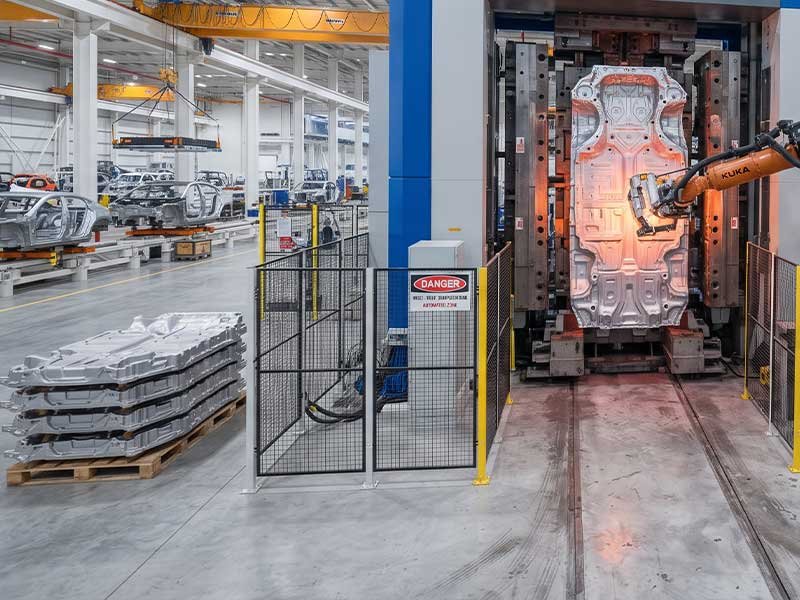
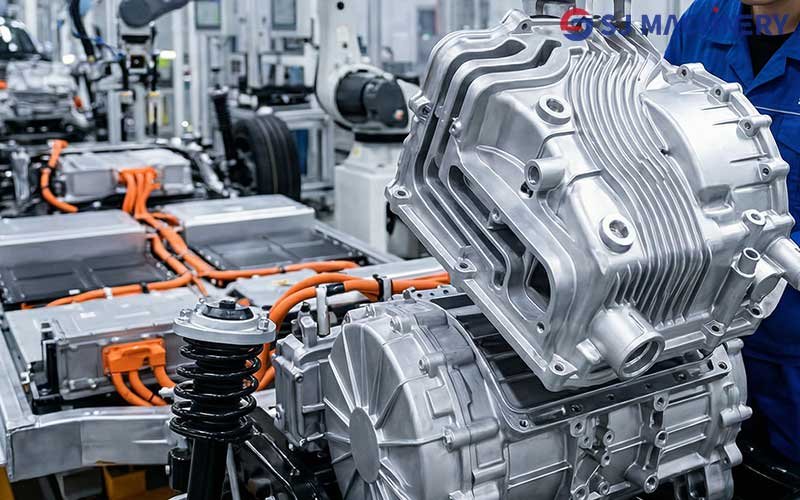
Three-electric components and integrated body castings attract the most industrial attention. The mega-casting technology consolidates over 70 separate stamped parts into a single aluminum casting, cutting assembly welding points and lowering body weight by approximately 10%, which accelerates global OEM adoption of large-scale integrated castings. Thermal management precision castings including multi-way valves and fluid connectors also witness robust demand as battery and motor thermal safety standards tighten continuously.
2. Mainstream Materials and Dominant Casting Processes
Lightweight aluminum alloys dominate new energy castings, supplemented by magnesium alloys and high-performance cast iron/steel for specific load-bearing and high-temperature parts. Different casting technologies have formed clear market segmentation to match component functionality, production volume and precision demands.
Table 2: Mainstream Casting Processes for New Energy Castings, Applicable Parts & Feature Summary
| Casting Technology | Representative NEV Components | Core Advantages & Limitations |
|---|---|---|
| High-Pressure Die Casting (HPDC) | Motor/E-control housings, reducer casings, various brackets, large mega-cast underbodies | Short cycle time, ultra-high productivity, suitable for thin-wall mass production; primary choice for integrated gigacasting solutions |
| Investment Casting (Lost Wax Precision Casting) | Thermal management pipe elbows, pump valve inner shells, sensor brackets, miniature precision mechanical parts | Tight dimensional tolerances, superior surface finish; generally requires supporting CNC machining for threads, sealing surfaces and positioning datum |
| Low-Pressure & Gravity Die Casting (LPDC/Gravity Casting) | Chassis safety parts (steering knuckles, control arms, subframes), water-cooled motor housings with high air-tightness requirements | Dense internal metallurgical structure; achieves outstanding tensile and yield strength after standardized heat treatment |
HPDC occupies 63.6% market share among all NEV aluminum casting processes in 2025, driven by mass production needs of mainstream EV platforms. Investment casting retains irreplaceable value for intricate thermal management fluid components, where complex internal geometries cannot be realized by conventional die casting. Most high-performance safety castings for chassis rely on low-pressure or gravity casting to avoid internal defects that threaten vehicle safety.
3. Core Evaluation Criteria for Casting Manufacturers in B-end Supply Chains
For casting manufacturers targeting domestic and overseas Tier 1 and secondary supply businesses, buyers impose stringent multi-dimensional assessment standards. Simply supplying rough casting blanks loses competitiveness; customers prefer turnkey solutions integrating casting, CNC machining services and surface treatment. Five key indicators dominate supplier audits:
- Leak Testing: All liquid-cooled sealed components must undergo 100% helium or water immersion leak inspection. Porosity and microcracks leading to leakage are classified as critical defects.
- Material & Heat Treatment Stability: Many lightweight structural castings adopt heat-treatment-free aluminum alloys; parts requiring T4/T6 thermal treatment demand rigorous process traceability to guarantee consistent mechanical properties.
- Internal Cleanliness Standards: Motor and inverter cavities as well as cooling channels enforce milligram-level control of residual metal debris, preventing coolant channel blockage or electrical short circuits.
- Full-Service Capacity: Casting + CNC Machining: OEMs and Tier 1 partners prioritize suppliers equipped with in-house precision machining workshops to deliver finished components directly.
- Automotive Quality Certification: IATF 16949 certification acts as the minimum market access threshold for all automotive casting suppliers.
4. Industry Trends & Outlook
The structural shift within automotive castings will continue over the next decade. Demand for traditional ICE castings will keep declining, while new energy castings maintain double-digit growth. Thermal management precision castings and three-electric structural parts represent the optimal transformation direction for traditional foundries.
Casting manufacturers must invest in two core capabilities to capture market opportunities: first, mastering large integrated die casting or precision investment casting technology to meet complex NEV component requirements; second, building mature CNC machining services to realize one-stop finished component delivery. Suppliers that can combine stable casting production, precision machining, strict quality control and complete automotive certification will gain long-term advantages in global NEV supply chains.