The Industrial Stainless Steel Hose Coupler is a mission-critical connection component widely deployed in high-pressure hydraulics, pneumatic circuits, marine infrastructure, chemical processing and corrosive industrial environments. For wholesalers, equipment OEMs and system integrators, a failed hose coupler joint can trigger unplanned production shutdowns, fluid leakage, safety hazards and massive maintenance costs.
Industry statistics show roughly 62% of hydraulic system breakdowns originate from fitting connection failures, while high-quality stainless steel couplings can cut fluid leakage incidents by over 75% compared to generic carbon steel alternatives.
When sourcing from a professional stainless Steel Hose Coupler supplier, B2B purchasers evaluate far more than surface pricing. Procurement decisions balance technical compliance, manufacturing precision, quality certification and stable supply chains. Many buyers also require custom stainless Steel Hose Coupler including special thread specifications, bent configurations and branded OEM machining to match unique equipment designs.
Among mainstream North American fluid connection standards, O-Ring Face Seal (ORFS) and JIC 37° Flare remain the two most popular choices for industrial stainless steel hose coupler assemblies.
Suijin Machinery breaks down buyer evaluation frameworks, contrasts ORFS and JIC performance, and delivers actionable selection advice for your fluid system projects.
1. S.T.A.M.P Principle: Core Technical Evaluation Standard for Industrial Stainless Steel Hose Coupler
Professional B2B procurement teams adopt the universal S.T.A.M.P checklist to verify every batch of industrial stainless steel hose coupler before order confirmation. Every parameter mismatch creates hidden operational risks.
Table 1: S.T.A.M.P Evaluation Framework for Industrial Stainless Steel Hose Coupler
| Parameter | Key Evaluation Points for Stainless Steel Hose Coupler | Common Industry Requirements |
|---|---|---|
| S – Size | ID/OD dimension, thread standard (NPT, BSP, JIC, metric), thread tolerance | Strict interchangeability with existing piping; micron-level thread precision |
| T – Temperature | Continuous working range, thermal expansion impact on sealing | Stainless steel substrate: -425°F ~ 1200°F; seal temperature limited by elastomer type |
| A – Application | Hydraulic, pneumatic, marine, chemical corrosion, mobile heavy machinery | Define sealing structure: ORFS, JIC flare, bite-type ferrule connection |
| M – Material | 304 vs 316/316L stainless steel; MTR material test reports | 316L preferred for offshore & acidic chemical environments for anti-pitting corrosion |
| P – Pressure | Rated working pressure, burst pressure, safety factor, impulse resistance | Premium stainless steel couplers support 6,000 PSI up to 20,000 PSI with ≥4:1 safety ratio |
Beyond S.T.A.M.P specifications, buyers audit production processes: high-grade industrial stainless steel hose coupler relies on CNC turn-mill composite machining to control surface roughness. Internal casting forging defects such as pores or slag inclusions must be eliminated to avoid rupture under cyclic high pressure. Post-machining passivation treatment is mandatory to enhance stainless steel anti-rust performance.
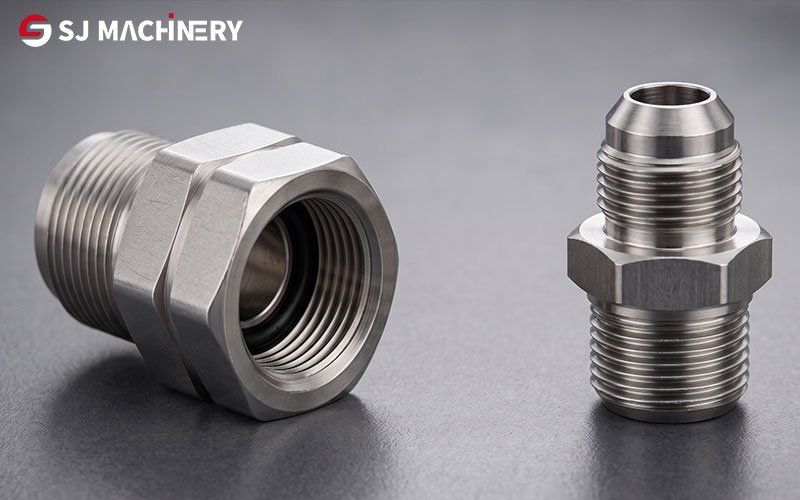
2. ORFS vs JIC 37° Flare: Working Mechanism Difference
The fundamental distinction between the two fitting types lies in sealing logic:
ORFS (O-Ring Face Seal):
Elastic soft sealing. A replaceable O-ring embedded in the male fitting groove gets compressed between flat faces. Threads only provide clamping force and take no sealing responsibility. The elastomer absorbs assembly deviation and system vibration.
JIC 37° Flare (SAE J514):
Metal-to-metal hard sealing. The 37° conical surfaces of male fitting and flared tube squeeze tightly to form a seal. Sealing performance heavily depends on surface finish and accurate tightening torque.
3. Head-to-Head Performance Comparison: ORFS and JIC Stainless Steel Hose Coupler
Table 2: ORFS vs JIC 37° Flare Technical & Operational Comparison
| Performance Metric | ORFS O-Ring Face Seal Coupler | JIC 37° Flare Coupler |
|---|---|---|
| Sealing Reliability | Excellent; O-ring compensates minor scratches & assembly tolerance | Good; prone to leakage with surface contamination, scratches or improper torque |
| Vibration Resistance | Outstanding; elastomer absorbs pressure pulse & mechanical vibration | Moderate; repeated vibration loosens metal contact surfaces gradually |
| Typical Working Pressure | Up to 6,000 PSI+, excellent impulse endurance | 3,000 – 5,000 PSI; pressure rating drops significantly for large sizes |
| Reusability | High; replace low-cost O-ring, metal body reusable repeatedly | Limited; metal cone suffers plastic deformation after 2–3 disassembly cycles |
| Installation Tolerance | Wide; less strict torque control required | Narrow; over-torque permanently damages flare cone; under-torque causes leaks |
| Temperature Limitation | Restricted by O-ring elastomer (max ~200°C for standard compounds) | Broad; pure metal seal, limited only by stainless steel alloy grade |
| Upfront Manufacturing Cost | Higher (precision groove machining) | Lower; mature, simplified processing |
4. Application Selection Guidance for Industrial Stainless Steel Hose Coupler
Selecting the correct coupling standard directly lowers your total cost of ownership (TCO). Global fluid power market data indicates ORFS fittings account for 53% of new high-vibration hydraulic equipment projects, while JIC 37° flare maintains dominant share in legacy machinery replacement markets.
Recommended ORFS Industrial Stainless Steel Hose Coupler Scenarios
- High-pressure hydraulic systems: excavators, injection molding machines, automated production lines
- Equipment requiring zero leakage and low downtime risk
- Positions needing frequent disassembly for maintenance
- Mobile machinery enduring continuous vibration and pressure pulsation
Recommended JIC 37° Flare Stainless Steel Hose Coupler Scenarios
- Extreme high-temperature environments where rubber O-rings cannot survive
- Medium-pressure general industrial fluid transmission
- Cost-sensitive conventional projects
- Aftermarket spare parts for older North American standard machinery
5. B2B Sourcing Checklist: Choose Qualified Stainless Steel Hose Coupler Supplier & Custom Stainless Steel Hose Coupler Service
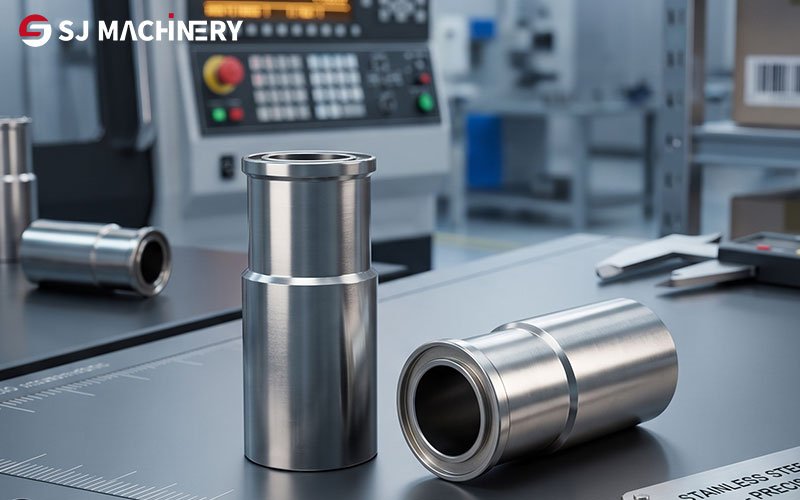
When partnering with a stainless Steel Hose Coupler supplier, technical capability and stable supply capacity decide long-term cooperation quality. Reputable manufacturers support custom stainless Steel Hose Coupler for non-standard projects, covering custom angles, special thread types, laser marking and drawing-based rapid prototyping.
Table 3: Supplier Qualification Audit Checklist for Stainless Steel Hose Coupler
| Audit Category | Key Verification Items |
|---|---|
| Quality System Certification | ISO 9001 baseline; IATF 16949 for automotive hydraulic projects; complete MTR material certificates |
| Testing Infrastructure | Spectrometer material testing, CMM dimensional inspection, hardness testing, high-pressure burst test bench |
| Production Precision | CNC turn-mill workshop; controlled micron-level tolerance; 100% inspection for critical order batches |
| Customization Support | OEM/ODM service, SolidWorks/AutoCAD drawing support, fast sample delivery for custom stainless steel hose coupler |
| Commercial & Supply Terms | Stable lead time, flexible MOQ for trial orders, tiered bulk pricing, consistent on-time delivery rate (OTD) |
Many buyers mistakenly focus solely on unit price. Mature procurement teams prioritize total cost of ownership. Premium industrial stainless steel hose coupler reduces unplanned shutdown, fluid loss and component replacement frequency, delivering better long-term economic benefits despite higher initial procurement cost.
6. Conclusion
As demand for corrosion-resistant high-pressure fluid connections keeps rising across marine, energy and automation sectors, the global stainless steel high-pressure fitting market is projected to achieve a 5.8% CAGR through 2034. Whether you select ORFS or JIC 37° flare industrial stainless steel hose coupler, strictly follow the S.T.A.M.P principle for technical verification.
If you need standard specifications or bespoke designs, collaborate with a verified stainless Steel Hose Coupler supplier offering reliable quality control and flexible custom stainless Steel Hose Coupler development. Share your system pressure, temperature, fluid medium and thread requirements, and Suijin Machinery can deliver optimized coupling solutions matching your exact operating conditions.
Contact our engineering team to get datasheets, sample support and quotation for standard & custom industrial stainless steel hose coupler. We provide OEM machining, third-party test documentation and stable bulk delivery for global wholesalers and equipment manufacturers.