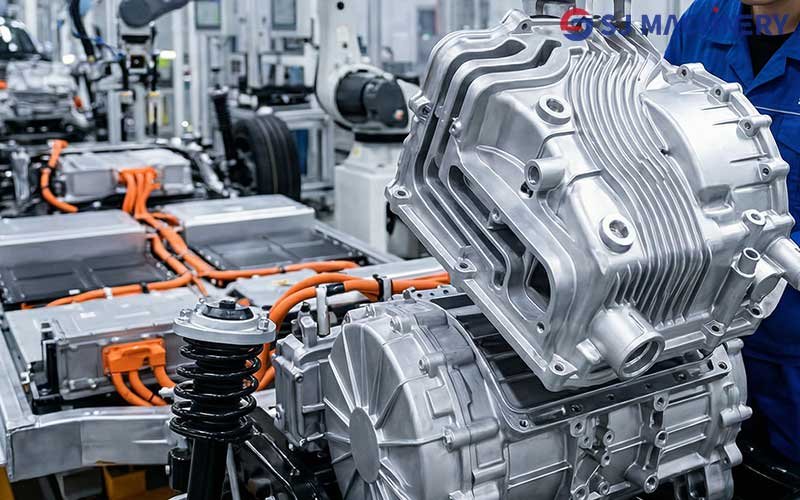
As a professional precision investment casting manufacturer, we are committed to providing high-quality, high-precision casting solutions for global new energy vehicle (NEV) manufacturers. With the rapid development of the global NEV industry, precision investment castings (also known as lost-wax castings) have become an indispensable core component in NEV manufacturing, relying on their unique advantages of high precision, complex structure forming, light weight, and high strength.
This article focuses on the application scenarios, market potential, core advantages and competitive patterns of precision investment castings in the NEV field, to help global customers fully understand the broad application prospects of this technology.
1. Core Application Scenarios in New Energy Vehicles
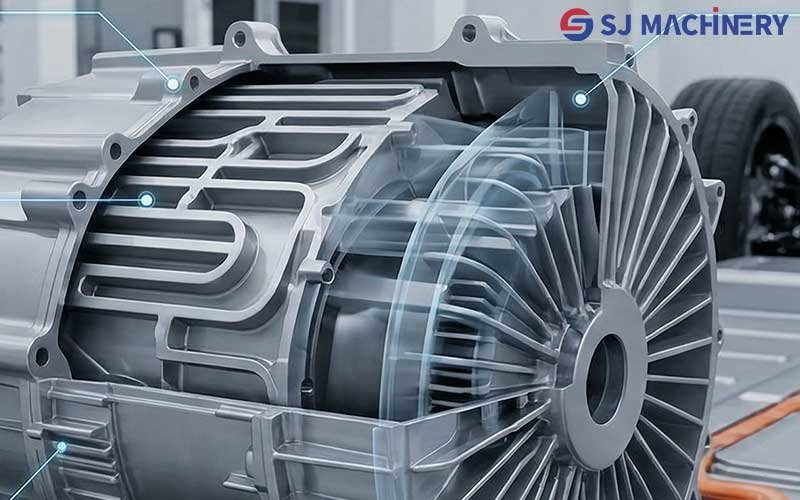
Precision investment casting excels in manufacturing parts with complex shapes, thin walls, high precision, smooth surfaces and good internal density. It is mainly used in the core components of NEVs, focusing on the “three-electric system” (motor, battery, electronic control) and high-end chassis parts, which are critical to the performance, safety and durability of NEVs.
| Application Category | Specific Parts | Material Requirements | Core Advantages of Investment Casting | Application Value for NEVs |
| Motor System | Drive motor housing, electric bridge housing, rotor core, stator support | Aluminum alloy, magnesium alloy, high-strength steel | Integral forming of complex cooling channels; high precision (CT4-CT6), zero leakage; light weight and high strength | Improve heat dissipation efficiency by 30%+; reduce weight by 40%+ compared with cast iron; adapt to 800V high-voltage platform |
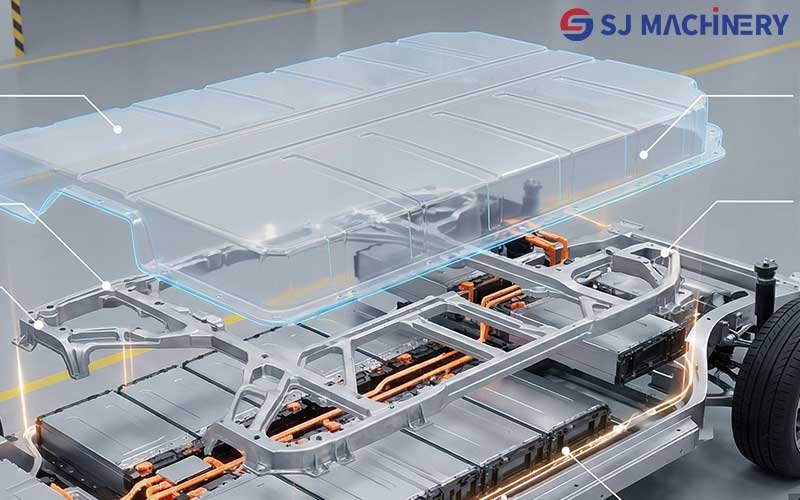
| Battery System | Battery pack upper cover, end plate, water-cooled plate, structural bracket | Aluminum alloy, magnesium alloy, corrosion-resistant steel | High rigidity, good sealing performance; integral forming of complex heat dissipation structure; corrosion resistance | Ensure battery safety and stability; reduce battery pack weight by 15-25%; improve heat dissipation uniformity |
| Electronic Control System | SiC module cooling housing, water-cooled substrate, inverter shell | High thermal conductivity aluminum alloy, stainless steel | Ultra-precise flow channel forming; high flatness (Ra≤1.6μm); low stress | Adapt to high-power SiC modules; reduce energy loss; ensure stable operation of electronic control system |
| Transmission System | Reducer housing, gearbox components, differential case | High-strength alloy steel, ductile iron | Complex inner cavity forming; high strength and wear resistance; low noise | Improve transmission efficiency; extend service life; reduce NVH (noise, vibration, harshness) |
| Hydrogen Fuel Cell (FCV) | Bipolar plate, manifold, end plate, cooling flow channel components | Stainless steel, titanium alloy, superalloy | Micron-level flow channel precision; corrosion resistance; air tightness; ultra-thin wall (0.5-1.0mm) | Key solution for FCV large-scale production; improve fuel cell efficiency and service life |
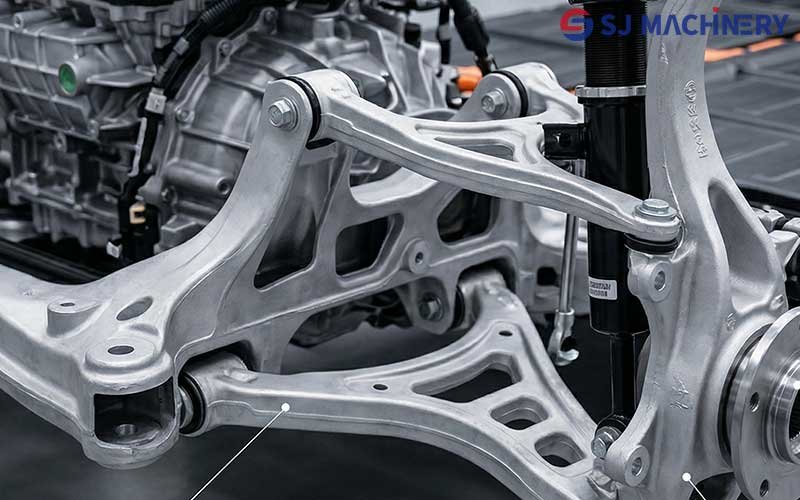
| Chassis System | Control arm, steering knuckle, suspension bracket | High-strength steel, aluminum alloy | Light weight, high fatigue life; high dimensional precision; good impact resistance | Reduce vehicle weight; improve driving stability and safety; extend chassis service life |
2. Global Market Scale and Growth Potential
Driven by the global “carbon neutrality” strategy and the rapid popularization of NEVs, the demand for precision investment castings in the NEV field is showing explosive growth. The following data reflects the huge market potential and broad development prospects:
|
Indicator
|
2023
|
2025 (Forecast)
|
2030 (Forecast)
|
|---|---|---|---|
|
NEV Precision Investment Castings Usage per Vehicle (kg)
|
75-85
|
80-90
|
100-120
|
|
Global Market Size (Billion USD)
|
18.2
|
32.5-38.8
|
85.0-98.0
|
|
Asia-Pacific Market Share (%)
|
44
|
48-50
|
52-55
|
|
North American Market Share (%)
|
28
|
27-29
|
25-27
|
|
European Market Share (%)
|
22
|
21-23
|
18-20
|
Key Notes: The Asia-Pacific region is the fastest-growing market, driven by China, India and other countries’ NEV industry boom; North America and Europe focus on high-end market segments such as hydrogen fuel cell components and high-performance motor parts; the demand for precision investment castings in the 800V high-voltage platform and hydrogen fuel cell vehicle (FCV) fields will become a new growth pole after 2025.
3. Core Competitive Advantages of Precision Investment Castings
|
Precision
|
Complex Structure Forming
|
Light Weight Performance
|
Cost (for Complex Parts)
|
Applicable NEV Parts
|
|
|---|---|---|---|---|---|
|
Precision Investment Casting
|
High (±0.05~0.1mm, CT4-CT6)
|
Excellent (integral forming of complex flow channels/thin walls)
|
Excellent (40%+ weight reduction compared with cast iron)
|
Low (fewer assemblies, less waste)
|
Three-electric system core parts, FCV key parts
|
|
High-Pressure Die Casting
|
Medium (±0.1~0.3mm, CT7-CT9)
|
General (difficult to form complex micro flow channels)
|
Good (30%+ weight reduction compared with cast iron)
|
Low (only for simple large parts)
|
Simple body structure parts, ordinary motor housings
|
|
Forging
|
Medium (needs secondary machining)
|
Poor (difficult to form complex shapes)
|
Good (high strength, light weight)
|
High (high material waste, complex process)
|
Simple structural parts, high-strength gears
|
4. Key Driving Factors for Market Growth
– Lightweight Demand is Imperative: For NEVs, every 10% weight reduction can increase cruising range by 5-8%. Precision investment castings made of aluminum/magnesium alloys can reduce weight by 40-50% compared with cast iron, which is the core solution to improve cruising range.
– Upgrading of Three-Electric System Performance: The popularization of 800V high-voltage platforms, SiC power modules and oil-cooled motors has put forward higher requirements for parts’ precision, sealing and heat dissipation. Precision investment casting is the only process that can simultaneously meet the requirements of precision, complexity, strength and cost.
– Technological Innovation Reduces Costs: The application of 3D printing wax patterns/core technology shortens the development cycle by 60-70% and reduces costs by 40%; AI simulation and intelligent detection technology increase the pass rate from 85% to over 95%, further reducing production costs.
– Accelerated Localization Replacement: In the past, high-end NEV precision castings relied on imports from Germany and Japan. At present, leading manufacturers in China and other regions have realized 100% localization, with better cost performance and faster delivery cycle, which has promoted the global popularization of precision investment castings.
– Boom in Hydrogen Fuel Cell Vehicles: As a key component of FCVs, precision investment castings (such as bipolar plates, manifolds) have huge market demand. With the acceleration of FCV commercialization, they will become a new growth point for the industry.
5. Challenges and Solutions
1、Higher cost than ordinary die casting for simple parts
Optimize production process, adopt 3D printing and automated production lines to reduce unit cost; focus on high-value-added complex parts to enhance comprehensive cost advantage
2、Long production cycle of traditional investment casting
Introduce intelligent production equipment, realize full-process automation (vacuum coating, intelligent roasting), and shorten the production cycle from 3-7 days to 1-2 days
3、Competition from integrated die casting for large structural parts
Focus on the segmented fields of three-electric system, FCV key parts and ultra-precise parts, give play to the irreplaceable advantages of investment casting, and avoid homogeneous competition
4、Strict quality requirements from global NEV manufacturers
Establish a strict quality control system, adopt advanced detection equipment (AI visual detection, X-ray detection), and ensure that products meet international standards (ISO, ASTM, DIN)
6. Future
The global NEV industry is in a period of rapid development, and precision investment castings, as a key basic process for NEV high-endization and high-performance, have extremely certain application prospects:
– Short-term (1-3 years): High-speed growth (CAGR 15-20%), the penetration rate of precision investment castings in the three-electric system will increase from 39% to over 60%.
– Medium-term (3-5 years): Achieve dual breakthroughs in technology and cost, and become the standard process for 800V high-voltage platforms, SiC modules and hydrogen fuel cell vehicles.
– Long-term: Deeply integrate with 3D printing, AI and digital factories, form a global leading precision manufacturing industrial chain, and provide more high-quality, efficient and cost-effective casting solutions for the global NEV industry.
As a professional precision investment casting manufacturer, Suijin Machinery has rich experience in the NEV field, advanced production equipment and a strict quality control system, which can provide customized casting solutions for global NEV customers. We look forward to cooperating with you to seize the development opportunities of the NEV industry and create win-win results together.