In the European manufacturing industry, precision, efficiency, and reliability are the core demands for component processing. CNC machining, as a core technology in modern manufacturing, has become an indispensable part of industries such as automotive, aerospace, medical equipment, and precision engineering across Europe. For European customers who pursue high-quality production and lean manufacturing, understanding how CNC machining works is crucial to optimizing production processes, improving product quality, and reducing production costs. This article will systematically explain the working principle, core components, workflow, and key advantages of CNC machining, combined with scenarios commonly encountered in European manufacturing.
1. What is CNC Machining?
CNC machining is a subtractive manufacturing process that uses computer-controlled machines to remove material from a workpiece to achieve the desired shape, size, and surface quality. Unlike traditional manual machining, which relies on the experience and operation of workers, CNC machining realizes automated, precise, and repeatable processing through pre-programmed numerical control instructions. This technology not only improves processing accuracy but also enhances production efficiency, making it suitable for both small-batch customization and large-scale mass production—two scenarios that are widely used in European manufacturing.
For European customers, CNC machining is particularly important in fields with high precision requirements, such as German automotive parts manufacturing, Swiss watch component processing, and Italian aerospace component production. Its ability to maintain consistent precision even in long-term continuous operation meets the strict quality standards of the European market.
2. Core Components of a CNC Machining System
To understand how CNC machining works, it is first necessary to familiarize yourself with its core components. A complete CNC machining system consists of four key parts, each of which plays an irreplaceable role in the processing process.
2.1 CNC Controller (The “Brain” of the System)
The CNC controller is the core of the entire system, responsible for receiving, interpreting, and executing processing programs. It converts the pre-written G-code (the standard programming language for CNC machining) into electrical signals, which control the movement of the machine tool’s axes, the rotation speed of the spindle, and the feed rate of the tool. Modern CNC controllers (such as Siemens, Fanuc, and Heidenhain, which are widely used in Europe) are equipped with user-friendly interfaces, allowing operators to edit programs, adjust parameters, and monitor processing in real time. For European customers who value operational flexibility, the compatibility and scalability of the controller are important considerations when selecting CNC equipment.
2.2 Machine Tool (The “Body” of the System)
The CNC machine tool is the executive part of the system, including the frame, spindle, feed mechanism, and workbench. Common types of CNC machine tools in European manufacturing include CNC milling machines, CNC lathes, CNC routers, and CNC grinding machines, each suitable for different processing needs. For example, CNC lathes are used for processing cylindrical parts (such as automotive shafts), while CNC milling machines are suitable for processing complex-shaped parts (such as aerospace components). The rigidity and precision of the machine tool directly affect the processing quality—European-manufactured machine tools (such as DMG Mori, Haas, and Mazak) are renowned for their high rigidity and stability, which is one of the reasons why European customers trust local and international CNC equipment brands.
2.3 Cutting Tools (The “Tool” of Processing)
Cutting tools are the medium for removing material from the workpiece, and their quality and selection directly affect processing efficiency and surface finish. Common cutting tools include end mills, drills, turning tools, and reamers, which are made of high-hardness materials such as carbide, high-speed steel, and diamond. For European customers, choosing the right cutting tool is crucial—for example, in the processing of high-strength alloys (common in the European aerospace industry), carbide tools with high wear resistance are usually selected to ensure processing accuracy and tool life. In addition, tool change systems (such as automatic tool changers, ATC) on CNC machine tools enable rapid tool switching, improving production efficiency.
2.4 Work holding Device (Fixing the Workpiece)
The work holding device is used to fix the workpiece on the machine tool’s workbench, ensuring that the workpiece does not move during processing. Common workholding devices include vices, clamps, fixtures, and chucks. For European customers who pursue high precision, the design and selection of workholding devices must match the shape and size of the workpiece to avoid deformation or displacement during processing. For example, in the processing of precision medical parts (such as Swiss medical implants), custom fixtures are often used to ensure the stability and precision of the workpiece.
3. The Working Process of CNC Machining
The working process of CNC machining can be divided into 5 key steps, from design to finished product, forming a complete closed loop. Each step is closely linked, and the quality of each link directly affects the final processing effect.
3.1 Design the Part and Create a 3D Model
The first step is to design the 3D model of the part according to the customer’s requirements. European manufacturers usually use professional CAD (Computer-Aided Design) software, such as SolidWorks, AutoCAD, or Catia, which are widely used in the European market. The 3D model must accurately reflect the shape, size, tolerance, and surface quality requirements of the part—this is the basis for subsequent programming and processing. For European customers, the 3D model also needs to comply with European industrial standards (such as ISO standards) to ensure compatibility with subsequent production links.
3.2 Generate G-Code (Programming)
After completing the 3D model, CAM (Computer-Aided Manufacturing) software is used to convert the model into G-code—a set of numerical instructions that the CNC controller can recognize. The CAM software simulates the processing process, optimizes the tool path, and sets processing parameters (such as spindle speed, feed rate, and cutting depth) according to the material of the workpiece (such as aluminum, steel, or plastic) and the type of cutting tool. For European customers, programming optimization is particularly important—it can reduce cutting time, save material, and avoid tool wear. For example, in the processing of complex parts, the CAM software can optimize the tool path to avoid unnecessary retractions, improving processing efficiency.
3.3 Set Up the CNC Machine Tool
Before processing, the operator needs to set up the CNC machine tool, including installing the cutting tool, fixing the workpiece with a workholding device, and calibrating the tool and workpiece. Tool calibration is to determine the position of the tool relative to the workpiece, ensuring that the processing position is accurate. Workpiece calibration is to confirm the origin of the workpiece (the reference point for processing), which is the key to ensuring processing precision. In European manufacturing workshops, operators usually use professional calibration tools (such as touch probes) to improve calibration accuracy and efficiency—this is in line with the European pursuit of lean manufacturing.
3.4 Execute the Processing Program
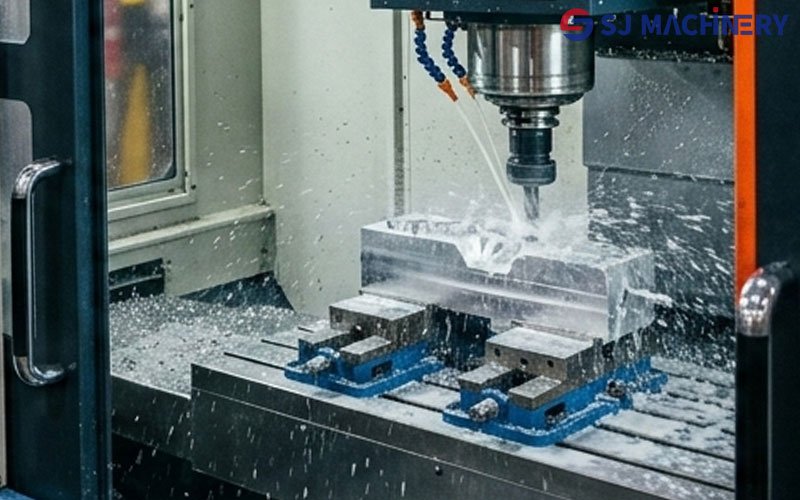
After the setup is completed, the operator loads the G-code into the CNC controller and starts the processing program. The CNC controller interprets the G-code and sends electrical signals to control the movement of the machine tool’s axes (usually X, Y, Z axes for 3-axis machining, and more axes for complex processing) and the rotation of the spindle. The cutting tool moves according to the preset path, removing excess material from the workpiece bit by bit. During the processing process, the CNC controller monitors the processing status in real time, and if an error occurs (such as tool breakage or workpiece displacement), it will automatically stop processing to avoid waste of materials and damage to the machine tool. This automated processing method not only reduces the labor intensity of operators but also ensures the consistency of product quality—an advantage that is highly valued by European customers who pursue batch stability.
3.5 Post-Processing and Quality Inspection
After the processing is completed, the workpiece is removed from the machine tool, and post-processing is performed, such as deburring (removing burrs generated during cutting), polishing (improving surface finish), and heat treatment (enhancing the hardness of the workpiece). Then, quality inspection is carried out to confirm whether the size, shape, and surface quality of the workpiece meet the customer’s requirements. European manufacturers usually use high-precision inspection equipment, such as coordinate measuring machines (CMMs) and optical measuring instruments, to ensure that the products meet European quality standards. For European customers, quality inspection is a key link—only products that pass the inspection can be put into the next production link or delivered to the customer.
4. Key Advantages of CNC Machining for European Customers
For European customers, CNC machining has obvious advantages compared with traditional manual machining, which is why it is widely used in European manufacturing. These advantages are closely related to the core demands of the European market for precision, efficiency, and sustainability.
4.1 High Precision and Consistency
CNC machining relies on computer control, which avoids the errors caused by manual operation. The processing accuracy can reach ±0.001mm, which meets the strict precision requirements of European industries such as aerospace, medical equipment, and automotive. In addition, CNC machining can ensure that each workpiece has the same size and shape, even in large-scale mass production—this is crucial for European customers who pursue product standardization.
4.2 High Efficiency and Cost-Effectiveness
CNC machine tools can work continuously for 24 hours (with automatic feeding devices), which greatly improves production efficiency compared with traditional manual machining. For European customers, higher efficiency means shorter production cycles, faster delivery, and lower unit production costs. In addition, the optimization of the tool path and the reduction of material waste also help to reduce production costs—this is in line with the European concept of cost control and sustainable development.
4.3 Flexibility and Versatility
CNC machining can process a variety of complex-shaped parts by changing the G-code, without the need to replace a large number of fixtures and tools. This flexibility makes it suitable for small-batch customization and multi-variety production—two scenarios that are increasingly common in the European market. For example, European automotive manufacturers often need to produce custom parts for different models, and CNC machining can quickly adapt to these changes, improving the flexibility of production.
4.4 Safety and Reliability
Modern CNC machine tools are equipped with a variety of safety protection devices, such as emergency stop buttons, protective covers, and overload protection, which ensure the safety of operators during processing. In addition, the stable performance of CNC machine tools reduces the failure rate, ensuring the smooth progress of production—this is important for European manufacturers who value production safety and stability.
5. Conclusion
CNC machining is a highly automated, precise, and efficient manufacturing technology that plays an important role in the European manufacturing industry. Its working principle is based on the cooperation of CNC controllers, machine tools, cutting tools, and work holding devices, through design, programming, setup, processing, and inspection, to realize the high-quality processing of parts. For European customers, understanding how CNC machining works can help them better select processing equipment, optimize production processes, and improve product quality, thus enhancing their competitiveness in the global market.
With the continuous development of technology, CNC machining is moving towards higher precision, more intelligence, and more sustainability—such as 5-axis CNC machining, intelligent monitoring systems, and green processing technologies. These developments will further meet the changing needs of European customers, promoting the continuous progress of the European manufacturing industry.