Worm Gear Output Shafts for Solar Trackers serve as the critical torque-transfer safety component inside PV tracker worm reducers, yet many solar equipment OEMs face costly supply-chain and reliability headaches during new product development.
The global solar tracker market is expanding rapidly; valued at USD 73.35 billion in 2026, it is forecast to reach USD 193.89 billion by 2031 at a CAGR of 21.46%, driven by utility-scale PV deployment and bifacial panel adoption that boosts energy yield by 15–25% versus fixed mounting systems.
As tracker designs grow more sophisticated, shaft failure modes including low-temperature brittle fracture, surface wear, and insufficient torsional load capacity become expensive liabilities: tracker downtime can cut power generation by 20–30% and trigger costly field service visits for remote solar farms.
Ningbo Suijin Machinery specializes as a single-source OEM partner for custom worm gear output shafts, offering drawing-based development, small-batch prototyping, and end-to-end casting plus CNC finishing. Our target customers are PV tracker design teams and system integrators developing next-generation tracker models who need flexible manufacturing support to iterate prototypes before full commercial release.

1. The Role of Worm Gear Output Shafts in PV Solar Trackers
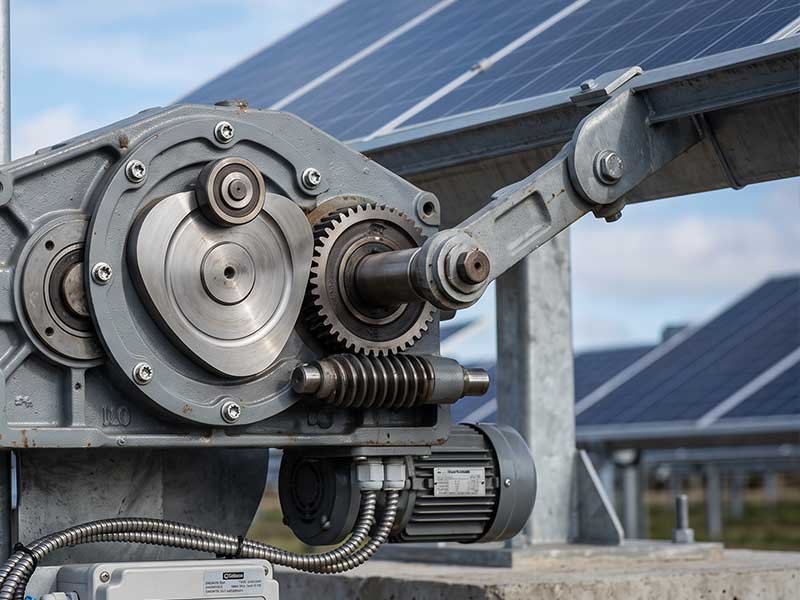
The worm gear output shaft connects the worm gear reducer to the tracker torque tube, delivering controlled rotational torque to tilt PV panels and maximize solar irradiance capture. It functions simultaneously as a transmission part and safety-critical structural element. Under wind gusts and freeze-thaw cycles, the shaft must sustain high static holding torque while maintaining tight dimensional consistency across thousands of units. Even minor tolerance drift can increase backlash, degrade tracking accuracy, and shorten the service life of the entire slewing drive assembly. We understand tracker field operating conditions beyond drawing dimensions and provide DFM feedback to refine component manufacturability and long-term reliability.
2. Custom Material & Manufacturing Capabilities
We select and supply materials matched directly to your site climate, torque load, and international standard requirements. Austempered Ductile Iron (ADI) is widely preferred for solar tracker worm shafts due to its balanced combination of high tensile strength, wear resistance, and low-temperature impact toughness.
ADI Material Grades for Solar Tracker Worm Gear Output Shafts
| Grade | Tensile Strength (Min) | Elongation | Low-Temperature Impact Requirement | Equivalent International Standard |
|---|---|---|---|---|
| QTD1050-8L | 1050 MPa | ≥8% | -40℃ Akv ≥35 J | ASTM 1050/750/7, EN-GJS-1050-6 |
| QTD1200-4L | 1200 MPa | ≥4% | Room temperature high strength variant | ASTM 1200/800-4 |
We also support ductile iron, cast steel and aluminum alloy options for alternate design requirements, conforming to ASTM, EN, JIS and other regional specifications. Material trial runs are available in small batches to validate performance before mass production.
All production starts from your 2D drawings, 3D CAD files or physical samples. Our engineering team delivers DFM reviews covering casting feasibility, draft angles, machining stock allowance and structural optimization recommendations. OEM branding support includes custom marking and packaging according to your brand requirements.
Our CNC machining package transforms raw cast blanks into finished shafts in-house. Operations include turning, milling, keyway cutting, splines, thread tapping and precision hole drilling. Typical achievable tolerance is ±0.02 mm on shaft diameters with controlled runout and coaxiality, eliminating alignment risks from multi-vendor handoffs.
We accept low-volume prototype orders, with rapid tooling options to reduce your upfront mold investment. Once prototypes pass validation, we seamlessly scale from small batch runs to high-volume serial production.
3. Quality Assurance: Consistent Inspection Even for Small Batches
Prototyping and low-volume orders often suffer from relaxed quality controls, which creates hidden risks that only surface after field installation. We apply identical inspection protocols for prototype and batch production.
Our quality scope includes dimensional verification, material certification, mechanical tensile testing and low-temperature Charpy impact testing. Non-destructive inspection such as PT, UT and RT can be arranged on request.
Ningbo Suijin Machinery Technology Co., Ltd. supplies First Article Inspection (FAI) reports, material certificates and test documentation for every order to support your internal qualification and customer audits.

4. OEM Cooperation Workflow-Ningbo Suijin Machinery Technology Co., Ltd.
Custom Shaft Development Process
| Step | Activity | Deliverable |
|---|---|---|
| 1 | Submit drawings, samples or site operating parameters | Application requirement review |
| 2 | Engineering DFM evaluation & commercial quotation | DFM report, formal quotation |
| 3 | Tooling development and sample manufacturing | Prototype casting blank / pre-machined sample |
| 4 | First article confirmation and design revision | FAI report, dimensional & material test data |
| 5 | Small batch production, heat treatment & CNC finishing | Finished machined shafts with full inspection |
| 6 | Packaging and shipment | Consolidated delivery with complete document package |
MOQ is flexible to accommodate R&D and pre-production projects. Lead times are quoted based on tooling complexity and order volume, and we can schedule phased deliveries aligned with your tracker project milestones.
5. Ideal Customers for Our OEM Worm Gear Output Shaft Service
- – PV tracker OEMs developing new single-axis or dual-axis tracker models
- – Solar system integrators seeking OEM private-label transmission components
- – R&D engineering teams requiring prototype validation with low minimum order quantities
- – Procurement teams aiming to consolidate casting and CNC machining into a single supplier to simplify quality accountability and reduce vendor management overhead
FAQ
Q1: What materials are available for solar tracker worm gear output shafts?
A: Our primary high-performance material is ADI (QTD1050-8L, QTD1200-4L). We also offer standard ductile iron, cast steel and aluminum alloy, matched to your load and environmental requirements.
Q2: Do you accept small batch and prototype orders? What is your MOQ?
A: Yes, small-batch development and prototyping are core service offerings. MOQ is flexible and negotiated per project. Rapid tooling options reduce your initial investment for R&D trials.
Q3: Can you manufacture fully OEM parts under our brand?
A: Yes. We can machine custom part marking and use your specified packaging to support OEM private label supply.
Q4: Can you provide low-temperature impact test reports down to -40℃?
A: Yes. We can supply Charpy impact test certificates at -40℃ for ADI grades such as QTD1050-8L, commonly specified for cold-climate solar farm deployments.
Q5: How long is the lead time for prototypes?
A: Prototype lead time depends on tooling complexity. We evaluate your drawing during DFM review and provide a clear timeline in the quotation.
Q6: Can your engineers perform DFM optimization on our existing shaft design?
A: Yes. Our DFM service identifies casting limitations, reduces machining waste and improves manufacturability while preserving your design performance targets.
Get Your Custom Worm Gear Output Shaft Quote
Our core advantage is single-source OEM delivery: casting + precision CNC machining for solar tracker worm gear output shafts, flexible small-batch prototyping, drawing-based customization and complete test documentation.
Send your 2D/3D drawings to receive a DFM assessment and quotation. Request ADI material specification documents or schedule a virtual factory review to discuss your PV tracker transmission component requirements. Contact us via email, WhatsApp or WeChat to start your component development project.