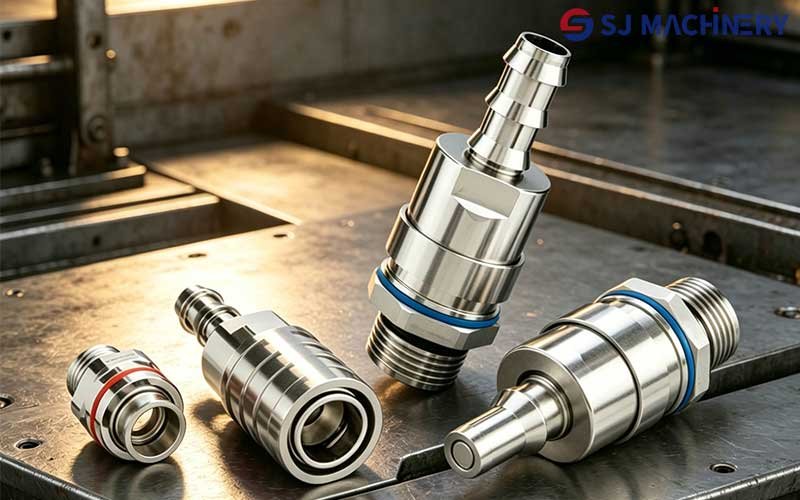
As AI servers, high-density data centers, and new energy storage systems rapidly upgrade, traditional air cooling can no longer handle high rack power density. Liquid cooling has become the mainstream thermal management solution worldwide, driving explosive growth in supporting core components—liquid cooling connectors and manifolds. These precision aluminum alloy parts determine the stability, tightness, and service life of the entire cooling loop, making high-quality casting and precision machining critical for mass production.
1. Current Market Status & Future Trends (2026–2030)
The global liquid cooling connectors and disconnectors market size was valued at USD 5.3 billion in 2025. The market is projected to grow from USD 5.53 billion in 2026 to USD 7.08 billion by 2034, exhibiting a CAGR of 4.3% during the forecast period. (Data Source : intelmarketresearch)
Liquid cooling connectors and disconnectors are specialized components designed for efficient heat dissipation in high-power applications. These systems ensure seamless coolant transfer while maintaining leak-proof seals under high pressure and temperature variations. They are critical in industries such as electric vehicle battery cooling, data center server thermal management, and power electronics temperature regulation. Data centers account for more than 60% of the overall application share, while energy storage and new energy vehicle thermal management have become the fastest-growing emerging tracks.
In 2026, the industry is undergoing three major deterministic upgrades:
- – Zero-leakage & high-pressure resistance: With single rack power rising to 80–150kW, connectors are upgraded to withstand higher hydraulic pressure, requiring long-term stable sealing without dripping under extreme temperature and vibration conditions.
- – Integrated & lightweight structure: Discrete single connectors are gradually replaced by integrated manifold modules to save installation space, reduce pipeline failure points, and adapt to high-density cabinet layout.
- – Blind-mate floating tolerance design: Advanced systems require radial and axial floating compensation to eliminate assembly errors and thermal deformation damage, becoming a standard configuration for high-end liquid cooling projects.

2. Core Technical & Process Requirements for Liquid Cooling Connectors
Liquid cooling connectors belong to high-reliability industrial fluid components. Unlike ordinary castings, they pursue internal compactness, dimensional consistency, and extreme air tightness. All qualified mass-production parts must meet strict metallurgical, dimensional, and testing standards.
Table 1: Key Technical Standards for Liquid Cooling Connector Castings
|
Inspection Item
|
Industry Standard Requirement
|
Purpose
|
|---|---|---|
|
Internal Metallurgy
|
No porosity, shrinkage or slag inclusion; Pass X-ray NDT (ASTM Level 2)
|
Prevent internal leakage and structural fatigue failure
|
|
Dimensional Tolerance
|
CT6–CT8 grade; key sealing hole ±0.05mm
|
Ensure precise assembly and interchangeability
|
|
Sealing Surface Finish
|
Ra ≤ 0.8μm, flatness ≤ 0.02mm/m
|
Guarantee zero-leakage fitting performance
|
|
Air Tightness Test
|
0.15MPa pressure holding, no visible leakage
|
Verify long-term cooling loop stability
|
|
Material Adaptability
|
A356 / ZL104 alloy, corrosion-resistant to glycol and dielectric fluid
|
Extend service life in complex cooling media
|
Table 2: Suitable Casting Processes for Different Liquid Cooling Parts
|
Product Type
|
Recommended Process
|
Process Advantages
|
|---|---|---|
|
Thin-wall integrated manifolds & high-sealing connectors
|
Low-Pressure Permanent Mold Casting
|
High compactness, minimal internal defects, excellent air tightness, ideal for high-end zero-leakage scenarios
|
|
Standard batch connector shells
|
Gravity Permanent Mold Casting
|
Cost-effective, stable output, multi-cavity mass production, balanced quality and price
|
|
Complex curved internal flow channel parts
|
Permanent Mold + Sand Core Composite Casting
|
Form complex inner cavities in one step, avoid welding leakage risks
|
3. Multi-Industry Applications of Liquid Cooling Connectors
Liquid cooling connectors and manifold castings are core sealing and fluid transmission components for high-power thermal management systems. With the continuous upgrade of high-heat-flux equipment, their application scenarios have expanded from traditional data centers to new energy storage, automotive thermal management, charging infrastructure, industrial high-precision equipment, and aerospace military fields, forming a diversified high-growth market layout.
| – Data Center & AI Computing (Largest Market Share) | Accounting for nearly 60% of the overall market demand, liquid cooling connectors are widely used in high-density server cabinets, GPU supercomputing centers, and CDU liquid cooling distribution systems. They support stable fluid circulation under 80–150kW high rack power, effectively solving the heat dissipation bottleneck of high-performance AI chips and ensuring 24/7 uninterrupted operation of computing equipment. |
| – New Energy Energy Storage (Fastest-Growing Track) | Ranking as the second largest application market with a 20% market share, liquid cooling connectors serve large-scale grid energy storage stations and industrial battery energy storage systems. Featuring vibration resistance, low-temperature resistance and zero-leakage stability, they maintain consistent temperature control for battery clusters, prevent thermal runaway, and improve the overall safety and service life of energy storage equipment. |
| – New Energy Vehicle Thermal Management | Applied in vehicle battery pack cooling loops, motor liquid cooling systems, and electric controller heat dissipation modules. Custom precision aluminum connectors adapt to complex vehicle vibration and extreme temperature environments, realizing reliable coolant transmission and precise temperature control for new energy vehicle core components. |
| – High-Power Charging Infrastructure | Ultra-fast DC charging piles generate massive heat during high-current charging. Special liquid cooling connectors support continuous heat dissipation for high-power charging modules, reducing equipment temperature rise, improving charging efficiency, and extending the service life of charging equipment. |
| – Industrial High-Precision Equipment | Widely used in laser processing equipment, high-speed CNC machine tools, frequency converters and servo systems. High-tightness connectors ensure stable liquid cooling circulation for high-load industrial equipment, avoiding precision errors caused by equipment overheating and guaranteeing consistent processing accuracy. |
| – Aerospace & Military Electronics | Military-grade liquid cooling connector components adapt to extreme working conditions of -55℃ to 125℃, with excellent shock resistance, vibration resistance and corrosion resistance. They are applied in radar equipment, airborne electronic systems and ship-borne cooling devices, meeting strict military-standard reliability requirements. |
4. Why Professional Permanent Mold Casting Beats Ordinary Sand Casting
Most failed liquid cooling connector cases come from loose internal structure and unstable dimensional tolerance caused by sand casting. Professional permanent mold casting (hard mold casting) adopts reusable metal molds and directional solidification principles, which greatly improves part compactness and surface finish. With standardized mold temperature control, molten metal purification, and riser feeding systems, manufacturers can effectively eliminate shrinkage, porosity, and cold shut defects — the core reasons for liquid cooling system leakage.
5. Suijin Liquid Cooling Manufacturing Solution.
As liquid cooling becomes the standard configuration for high-power thermal management, liquid cooling connectors are evolving toward higher precision, higher pressure resistance, and integrated modularization. Only standardized permanent mold casting processes and strict metallurgical quality control can meet the long-term reliable operation requirements of cooling systems. For global buyers seeking stable batch quality, zero-leakage performance, and cost-effective customization, professional casting manufacturers like Suijin Machinery provide the most competitive manufacturing solution.
Suijin Machinery is a professional diversified precision casting manufacturer focusing on liquid cooling and industrial thermal management components. Proficient in low-pressure casting, gravity permanent mold casting, and composite casting technologies, we provide one-stop OEM solutions from mold development, high-purity alloy casting, T6 heat treatment, CNC precision machining to 100% air tightness testing. With strict full-process quality control, Suijin delivers high-compactness, zero-leakage aluminum liquid cooling connectors and manifolds for global data center, energy storage, and new energy customers.