1. Introduction to Wet Sand Casting Process
Wet sand casting uses recyclable sand without the need for any chemical additives to bind the sand. It relies solely on sand, clay, and water, with water acting as the binder. Clay-bonded wet sand molding is the most economical molding method for most metal materials and mass production. Foundries equipped with the latest technology control equipment should progressively utilize wet sand control technology to repeatedly achieve optimal performance. These control devices include metal screening and separation, cooling of recycled sand, and precise dispensing of additives when mixing recycled sand.
In wet sand casting, a comparison between vertical and horizontal parting is necessary. For foundries producing small to medium-sized gray cast iron or ductile iron parts in mass production, vertical parting molding is more advantageous due to its relatively lower equipment costs, faster molding speed, fewer personnel required, and smaller compaction deviation. However, the vertical parting process has limitations in terms of gating system design and shape, as well as the use of complex cores, filters, chills, sleeves, and rammed cores.
Furthermore, when casting with highly fluid alloys, the high hydrostatic pressure of the metal can easily lead to metal penetration and sand adhesion.
2. The following points should be considered when choosing a wet sand casting method:
- The molding equipment must be capable of producing high-quality castings with uniform hardness.
- The patterns can be changed quickly.
- The loading and unloading of cores and molds should be mechanized.

3. Differences Between Horizontal and Vertical Parting Wet Sand Casting Processes
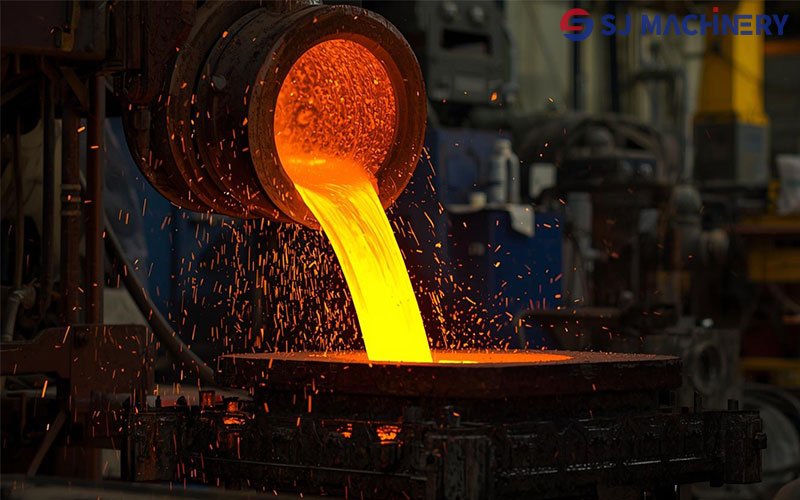
The wet sand casting process begins with using a 3D model of the part. A mold is then made from sand, and molten metal is poured into the mold to cast the part. The way the mold is made depends on the equipment; two common processes are horizontal and vertical parting.
Horizontal Parting Sand Casting
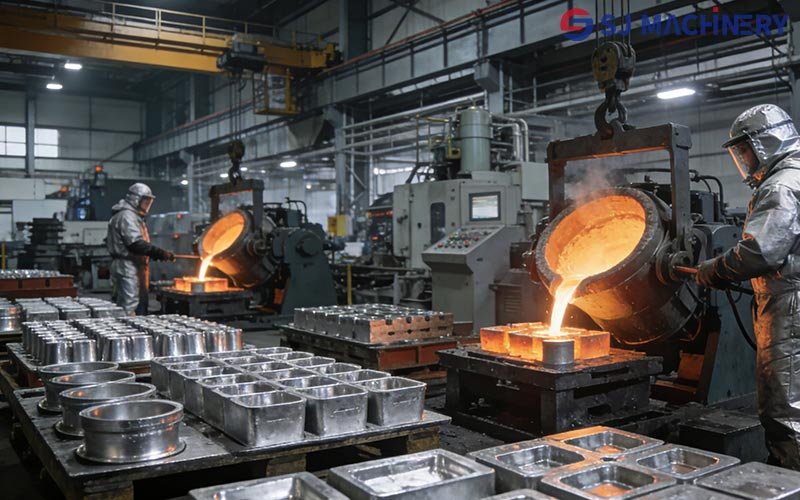
Horizontal parting sand casting has a lower mold (bottom of the mold) and an upper mold (top of the mold). Sand is poured into the lower mold to form the 3D model. The upper mold is also made using a similar independent process. After the sand mold is bonded, the patterns are removed from the upper and lower molds. The upper and lower molds are then locked together. Molten metal is poured into the sand mold through a gating system. Horizontal parting sand casting refers to the method of making and connecting the upper and lower molds. In this process, the upper and lower molds are filled with sand separately, and then the upper mold is placed on the lower mold to form the final casting.
Horizontal parting sand casting is ideal for small-batch production of castings. Because the mold making is simple, this method is economical. Many industries benefit from this traditional process, with common applications including the manufacture of gearboxes, pumps, and automotive engine blocks.
Vertical Parting Sand Casting
Vertical parting sand casting requires the mold plates to be placed on the sides rather than the top and bottom. One plate is called the platen, and the other is called the swing plate, as they both form half of the part model.
The mold plates are closed, and sand is poured in from the top. The platen and swing plate press against each other, compacting the sand into half of the desired mold shape. After the sand is bonded, the swing plate moves away and swings upwards to remove the mold section.
The mold section moves down the production line while the next mold section is being made. The first and second mold sections are brought together to form a cavity, into which the molten metal is poured.
Vertical parting sand casting can be used for mass production. It can produce a variety of products, including pipe fittings, exhaust manifolds, and brake discs.
4. How to Choose a Wet Sand Casting Process?
In the manufacture of non-ferrous alloy castings, vertical parting molding methods have been designed and are currently being promoted for the mass production of various alloy castings with specific characteristics. However, before this molding method can produce castings with the desired mechanical properties and achieve mass production on a considerable scale, metal mold casting remains advantageous as a method for mass production of aluminum alloy castings.
Horizontal parting wet sand casting remains one of the preferred molding methods for small and medium-sized foundries. Whether using the upper and lower mold method or the double-sided template method, it is suitable for the production of complex castings. Molds can be changed within one cycle, and it is efficient for both short-term and long-term production. However, manual operations need to be mechanized, and the entire equipment needs to be modified to ensure the production of castings with good surface finish and high dimensional accuracy.
Über Ningbo Suijin
Ningbo Suijin Machinery Technology Co, Ltd. is a professional manufacturer specializing in end-to-end casting solutions. With over a decade of experience in the industry, we focus on “customized R&D + high-precision production + full material compatibility” to provide customers in the machinery manufacturing, aerospace, petrochemical, automotive parts, and precision instrument industries with one-stop customized services from product design optimization to finished product delivery.