
Zentrifugalgussverfahren
Schleuderguss Einführung
Schleuderguss ist ein Metallumformungsverfahren, bei dem die Zentrifugalkraft als Hauptantriebskraft genutzt wird. Geschmolzenes Metall wird in eine mit hoher Geschwindigkeit rotierende Form gegossen, wo es sich unter der Zentrifugalkraft gleichmäßig an der Innenwand der Form verteilt, abkühlt und erstarrt und schließlich ein hohlzylindrisches, ringförmiges oder rohrförmiges Gussteil bildet.
Dieses Verfahren wird aufgrund der hohen Dichte, der hervorragenden mechanischen Eigenschaften und der hohen Produktionseffizienz der Gussteile häufig im Maschinenbau, im Rohrleitungsbau und in der Automobilindustrie eingesetzt. Es ist auch ein wichtiges Umformverfahren für Metallteile im Zusammenhang mit Werkzeugtaschen (z. B. rohrförmige Halterungen, Verbindungsstücke und verschleißfeste Buchsen).
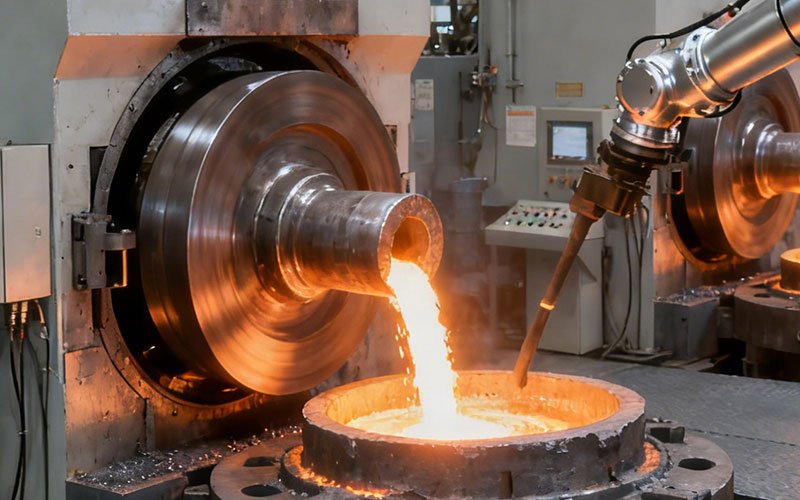
Zentrifugalgussverfahren
Die Kernlogik des Schleudergusses lautet: “Rotation der Form → Einfüllen des geschmolzenen Metalls → Verdichtung durch die Zentrifugalkraft → Abkühlung und Erstarrung → Entformung und Verarbeitung”. Der Prozessrahmen ist für die verschiedenen Prozesstypen (horizontal / vertikal / geneigt) gleich und unterscheidet sich nur in Details wie dem Einbau der Form und dem Gießverfahren.
Suijin Machinery bietet Standard-Prozessabläufe für die industrielle Großserienfertigung und gleichzeitig optimierte Lösungen für die kundenspezifische Fertigung in Kleinserien.
Schritt 1: Schimmelpilzvorbereitung und -inspektion
Vergewissern Sie sich, dass die Innenwand der Form glatt ist, die Abmessungen innerhalb der Spezifikationen liegen und keine Mängel vorhanden sind, die die Gussqualität beeinträchtigen; überprüfen Sie die strukturelle Sicherheit der Form, um Fehlfunktionen während der Hochgeschwindigkeitsrotation zu vermeiden.
Betriebsverfahren :
- Auswahl der Form: Wählen Sie die Form entsprechend der Gussart (Rohrform für horizontale Zentrifugation, Ringform für vertikale Zentrifugation). Das Material ist in der Regel eine hochfeste Legierung wie H13-Formenstahl und Cr12MoV (kleine Formen, die für Werkzeugaufbewahrungsbeutel-Zubehör geeignet sind, haben im Allgemeinen einen Innendurchmesser von 5-50 mm und eine Länge von 100-500 mm).
- Maßprüfung: Verwenden Sie Messschieber und Mikrometer, um die Toleranzen des Innendurchmessers, der Länge und der Wandstärke der Form zu überprüfen (Fehler ≤ ±0,05 mm), um die Maßhaltigkeit des Gussteils zu gewährleisten.
- Defekt-Inspektion: Prüfen Sie die Innenwand der Form visuell oder mit einem Endoskop, um Grate, Kratzer, Sandanhaftungen und andere Defekte zu entfernen (die Rauheit der Innenwand muss ≤ Ra3,2μm sein).
- Strukturelle Inspektion: Ziehen Sie Formflansche, Lager, rotierende Wellen und andere Verbindungselemente fest, um sicherzustellen, dass sie nicht locker sind (die Zentrifugalkraft ist während der Hochgeschwindigkeitsrotation extrem hoch; Lockerheit kann leicht zum Bruch der Form führen).
Schritt 2: Vorwärmen der Form und Beschichtung
Das Vorwärmen der Form verhindert Risse, die durch das plötzliche Abkühlen des geschmolzenen Metalls verursacht werden; das Auftragen eines Trennmittels verringert die Haftung zwischen dem Gussteil und der Form und verbessert die Oberflächenqualität.
Betriebsverfahren:
- Vorwärmen der Form: Verwenden Sie eine elektrische Heizung, eine Gasheizung oder eine Infrarotheizung, um die Temperatur der Form auf 150-350℃ zu erhöhen (die Temperatur variiert je nach Material: 150-200℃ für Gusseisen, 250-350℃ für Edelstahl); die Temperatur muss gleichmäßig sein, um örtliche Überhitzung oder Unterkühlung zu vermeiden (ein Thermometer kann zur Überwachung verwendet werden);
- Auftragen des Trennmittels: Nach dem Vorheizen wird ein Trennmittel (gängige Typen: Graphitpulversuspension, Wasserglas + Talkumbeschichtung, spezielles keramisches Trennmittel) gleichmäßig auf die Innenwand der Form aufgesprüht, wobei die Schichtdicke auf 0,1-0,3 mm kontrolliert wird;
- Sekundäres Trocknen: Halten Sie die Temperatur nach dem Aufsprühen noch 10-20 Minuten lang aufrecht, um sicherzustellen, dass das Trennmittel vollständig trocken ist (um zu verhindern, dass Feuchtigkeit verdunstet, was zu Porosität im Guss führen könnte).
- Technische Hinweise: Das Trennmittel muss gleichmäßig und ohne Fehlstellen oder Anhäufungen aufgetragen werden; kleine Formen für Zubehör für Werkzeugtaschen können mit automatischen Sprühgeräten beschichtet werden, um eine gleichmäßige Beschichtung zu gewährleisten.
Schritt 3: Einbau der Form und Einstellung der Geschwindigkeit
Fixieren Sie die Form und stellen Sie sie auf die optimale Geschwindigkeit ein, um eine gleichmäßige Verteilung des geschmolzenen Metalls unter der Zentrifugalkraft zu gewährleisten.
Betriebsverfahren:
- Einbau der Form: Befestigen Sie die vorgewärmte Form auf der Spindel der Schleudergussmaschine. Bei horizontaler Zentrifugation muss die Achse der Form vollständig mit der Spindel ausgerichtet sein (Vertikalitätsfehler ≤ 0,02 mm). Bei vertikaler Schleuderung muss die Form waagerecht aufgestellt werden (Horizontalitätsfehler ≤ 0,01 mm).
- Geschwindigkeitsberechnung: Berechnen Sie die optimale Geschwindigkeit auf der Grundlage des Innendurchmessers des Gussteils und der Metalldichte.
- Prüfung im unbelasteten Zustand: Starten Sie die Schleudergussmaschine und lassen Sie sie 5-10 Minuten lang unbelastet laufen, um die Rotationsstabilität der Form zu prüfen (Vibrationswert ≤ 0,1 mm/s). Der Gießvorgang kann erst fortgesetzt werden, wenn sichergestellt ist, dass keine Anomalien festgestellt wurden.
- Sicherheitsvorkehrungen: Während der Prüfung muss die Schutztür geschlossen sein, und die Bediener müssen sich vom rotierenden Bereich fernhalten. Die Geschwindigkeit darf den Nennwert der Form nicht überschreiten (in der Regel das 1,2-fache des berechneten Wertes).
Schritt 4: Metallschmelzen und Zusammensetzungsprüfung
Bei diesem Verfahren werden metallische Rohstoffe zu einer Metallschmelze geschmolzen, die bestimmte Anforderungen erfüllt und eine gleichmäßige Zusammensetzung sowie das Fehlen von Verunreinigungen gewährleistet.
Betriebsverfahren:
- Vorbereitung des Rohmaterials: Wählen Sie die Rohstoffe entsprechend dem Gussmaterial aus (z. B. Roheisen, Stahlschrott und Impfmittel für Gusseisen; Edelstahlknüppel für Edelstahl). Die Rohstoffe müssen sauber und frei von Öl und Rost sein (um die Reinheit des geschmolzenen Metalls nicht zu beeinträchtigen).
- Metallschmelzen: Verwenden Sie zum Schmelzen Geräte wie einen Mittelfrequenz-Induktionsofen oder einen elektrischen Lichtbogenofen, wobei Sie die Schmelztemperatur kontrollieren (Gusseisen 1300-1380℃, Edelstahl 1500-1550℃, Aluminiumlegierung 680-720℃). Zugabe von Desoxidationsmitteln (z. B. Ferromangan, Ferrosilizium) während des Schmelzens, um Verunreinigungen zu entfernen.
- Analyse der Zusammensetzung: Schnelle Analyse der chemischen Zusammensetzung des geschmolzenen Metalls (z. B. Kohlenstoff-, Silizium- und Mangangehalt) mit einem Spektrometer, um die Einhaltung von Industrienormen zu gewährleisten (z. B. müssen Gusseisenteile für Werkzeugaufbewahrungstaschen der Norm GB/T 9439-2010 entsprechen).
- Entfernen der Schlacke: Nach erfolgreichem Schmelzen lassen Sie das geschmolzene Metall 5-10 Minuten stehen, damit Verunreinigungen und Schlacke an die Oberfläche schwimmen können, und entfernen Sie sie dann mit einem Schaumlöffel (um zu verhindern, dass Verunreinigungen in das Gussteil gelangen und Fehler verursachen).
Schritt 5: Gießvorgang
Während sich die Form mit hoher Geschwindigkeit dreht, wird das geschmolzene Metall gleichmäßig in die Form gegossen, um eine vollständige Füllung und gleichmäßige Wandstärke zu gewährleisten.
Betriebsverfahren:
- Vorbereitung des Gießens: Vergewissern Sie sich, dass die Drehgeschwindigkeit der Form stabil auf dem eingestellten Wert liegt und die Temperatur des geschmolzenen Metalls den Anforderungen entspricht (Gießtemperatur 20-50℃ niedriger als die Schmelztemperatur);
- Gießverfahren: Horizontal zentrifugal: Verwenden Sie “End-Gießen” oder “Regen-Typ Gießen”, kontinuierlich Einspritzen von geschmolzenem Metall entlang der Anschnitt an einem Ende der Form (Durchflussmenge von 0,5-2L / s gesteuert, je nach Gusslänge angepasst), die Auswirkungen auf die Innenwand der Form zu vermeiden;Vertikal Centrifugal: Verwenden Sie “Center-Pouring”, spritzen geschmolzenes Metall in die Form durch den zentralen Anguss, um eine gleichmäßige Verteilung entlang des Umfangs zu gewährleisten;
- Kontrolle der Füllung: Beobachten Sie die Füllung des geschmolzenen Metalls während des Gießens (durch das Formbeobachtungsfenster oder ein Infrarot-Thermometer), um eine Unterbrechung des Flusses und ein Überlaufen zu vermeiden; passen Sie die Füllzeit an die Länge des Gussteils an (normalerweise 5-15 Sekunden für kleine rohrförmige Formstücke);
- Schrumpfungsbehandlung: Nach dem Gießen kann bei großen Gusswandstärken (>20 mm) eine kleine Menge geschmolzenes Metall am Anschnitt zugegeben werden, um Lunker während des Abkühlens zu vermeiden.
Schritt 6: Abkühlung und Erstarrungskontrolle
Kontrolle der Abkühlgeschwindigkeit, um eine gleichmäßige Erstarrung des geschmolzenen Metalls von außen nach innen zu gewährleisten und so innere Spannungen und Fehler zu reduzieren.
Operative Verfahren:
- Abkühlungsmethoden: Natürliche Abkühlung: Kleine Gussteile (z. B. Buchsen für Werkzeugaufbewahrungsbeutel) können 5-15 Minuten lang auf natürliche Weise in der Form abkühlen.
Zwangskühlung: Große Gussteile oder Metallteile mit hohem Schmelzpunkt (z. B. Rohre aus rostfreiem Stahl) werden 15-60 Minuten lang mit Wasser (Aufsprühen von Wasser auf die Außenwand der Form) oder Luft (Einblasen von Druckluft) gekühlt. - Steuerung der Kühlung: Die Abkühlgeschwindigkeit muss auf das Material abgestimmt sein (5-10℃/min für Gusseisen, 3-8℃/min für Stahl), um Rissbildung durch zu hohe Geschwindigkeit oder lockere Struktur durch zu geringe Geschwindigkeit zu vermeiden.
- Aufheizphase: Wenn die Oberflächentemperatur des Gussteils auf 300-400℃ sinkt, kann die forcierte Kühlung gestoppt werden, und das Gussteil sollte 5-10 Minuten lang in der Form gehalten werden, um innere Spannungen abzubauen.
- Technische Hinweise: Die Form muss während des Abkühlungsprozesses (bis zur vollständigen Erstarrung des Gussstücks) gedreht werden, um eine ungleichmäßige Wandstärke aufgrund der Schwerkraft zu vermeiden.
Schritt 7: Entformen und Vorreinigung
Sicheres Entformen, Entfernen von Steigleitungen, Graten und anderen überschüssigen Strukturen.
Betriebsverfahren:
- Entformungszeitpunkt: Wenn das Gussteil vollständig erstarrt ist und die Temperatur auf 200-300 °C gesunken ist (mit der Hand berührbar), stoppen Sie die Drehung der Form und aktivieren Sie die Entformungsvorrichtung (Auswerferstange beim horizontalen Schleuderguss, hydraulische Hebebühne beim vertikalen Schleuderguss);
- Sicheres Entformen: Kleine Gussteile können mit Hilfe von Hand entnommen werden; große Gussteile erfordern einen Kran, um Verformungen durch Kollisionen zu vermeiden;
- Vorläufige Reinigung: Verwenden Sie einen Winkelschleifer und eine Schleifmaschine, um Stege, Grate und andere Unebenheiten zu entfernen (Stege an Werkzeugtaschen sind in der Regel klein und können in einem Arbeitsgang entfernt werden); verwenden Sie eine Drahtbürste, um die Oberfläche des Gussteils von Trennmittelresten und Oxidhaut zu reinigen.
Schritt 8: Weiterverarbeitung und Qualitätskontrolle
Die maschinelle Bearbeitung verbessert die Präzision, und die Inspektion identifiziert Fehler, um sicherzustellen, dass die Gussteile den Nutzungsanforderungen entsprechen.
Operative Verfahren:
- Bearbeitung
- Qualitätskontrolle
- Rostschutzbehandlung
Suijin-Gießlösung
Der Kern des Schleudergusses besteht aus drei Hauptschritten: der präzisen Steuerung der Formrotation, dem Einfüllen des geschmolzenen Metalls sowie dem Abkühlen und Erstarren. Jeder Schritt erfordert die Abstimmung der Materialeigenschaften und der Gussstruktur (z. B. sollte bei kleinen Teilen der Schwerpunkt auf die Präzision der Form, die Gleichmäßigkeit der Beschichtung und den automatisierten Guss gelegt werden, um die Konsistenz in der Massenproduktion zu gewährleisten). Durch standardisierte Prozessabläufe können dichte, maßgenaue Metallhohlkörper stabil hergestellt werden, die eine äußerst haltbare und kosteneffiziente Formlösung für Metallteile in Werkzeugtaschen darstellen.